


Summary
Published by Conscious Solutions, this guide argues that local SEO is the most defensible digital channel for law firms in 2026 as AI Overviews erode top-of-funnel blog traffic. The core strategic shift is from informational content toward conversion-led, high-intent location and service pages targeting transactional queries.
Key pillars covered: Google Business Profile optimisation (32% of local pack ranking weight) including SRA number in the description, weekly posts, and UTM tracking; review management (20% weight) with specific guidance on ReviewSolicitors and Trustpilot for UK firms; hyper-local content with named solicitor authors, SRA credentials, and PAA-targeted FAQ sections; and citation building prioritising Law Society, Legal 500, Bing Places, and Apple Business Connect.
Schema markup is flagged as essential for Knowledge Panel accuracy, Local Pack eligibility, and AI Overview citation confidence, with validation via Google Rich Results Test required before deployment. Priority schema pages are contact, FAQ, staff bio, blog, homepage, service, and video pages.
Platform diversification beyond Google is recommended, with LinkedIn, YouTube, WhatsApp Business, and ReviewSolicitors highlighted as highest priority.
Contents
- 1. Introduction: The Defensible Advantage of Local SEO
- 2. The Strategy: Conversion-Led Local Authority
- 3. Google Business Profile & Engagement Signals
- 4. Review Management: The Reputation Moat
- 5. Hyper-Local Content & On-Page Strategy
- 6. Authority Building: Citations & Links
- 7. Platform Diversification: Beyond Google
- 8. Schema Markup for UK Law Firms
- 9. Local Ranking Factor Weights: 2026 Summary
- 10. Conclusions & Next Steps
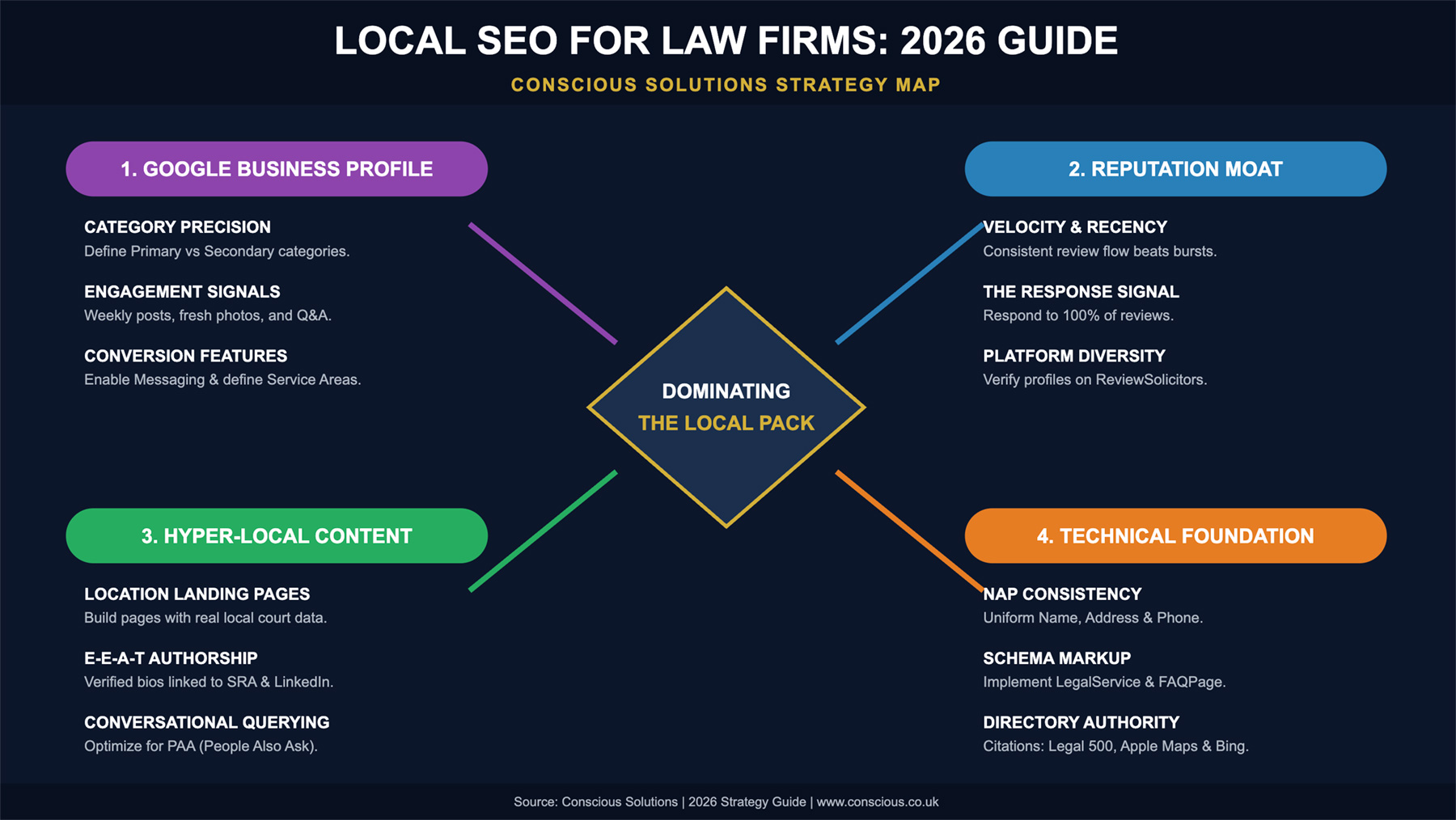
1. Introduction: The Defensible Advantage of Local SEO
To build local SEO authority and rankings for UK law firms in 2026, you must pivot from traditional “made-for-search” tactics toward a conversion-led KPI strategy that emphasises brand trust, AI visibility, multi-media diversification and off-platform signals.
As AI Overviews (AIO) and zero-click searches reduce traffic to top-of-funnel informational blog posts, local SEO for law firms remains the most defensible and high-converting digital asset for the UK legal industry. Unlike broad informational content, locally optimised service and contact pages, a robust Google Business Profile, and local insights and case studies cannot be summarised away by an AI.
2. The Strategy: Conversion-Led Local Authority
Traditional informational blog posts are losing visibility as Google’s AI Overviews answer top-of-funnel questions directly on the search page. The 2026 local seo strategy for UK law firms and solicitors, must focus on:
- High-Intent Practice Pages: Instead of broad guides (e.g., “What is a Will?”), focus on high-intent, location-specific service pages (e.g., “Will Writing Solicitors in Bristol”). These pages must serve commercial and transactional search intent and should be the primary investment of your content resource.
- Conversion-Optimised Design: Mobile-first web design containing optimised conversion signals in the first fold - the images, calls to action and trust signals must be immediately visible without scrolling.
- Niche “Super-Serving”: Law firms should super-serve narrow legal niches (e.g., “High-Net-Worth Divorce in London”, or “Local Property disputes in Bristol, 2026 Guide) to build a specialised brand that AI cannot easily generalise. Depth of expertise on a narrow topic is now more valuable than broad coverage.
- AEO & GEO (Answer Engine & Generative Engine Optimisation): Optimising for Answer Engine Optimisation (AEO) and Generative Engine Optimisation (GEO) involves using structured data, headings and concise expert question-and-answer legal summaries, alongside local expertise that AI agents can cite in conversational results.
- Reputation-Led Conversion: You cannot afford to waste a conversion. Negative reviews and poor first impressions will directly reduce your conversion rate. Audit your client journey end-to-end - from the initial enquiry call to onboarding. Train receptionists, set response time targets, and treat every review as a data point.
- Core Web Vitals as a Local Ranking Pre-Requisite: In 2026 your website cannot have speed issues or conversion friction. Ensure LCP is under 2.5s, INP under 200ms, and CLS under 0.1 using CrUX field data from Google Search Console - not just lab scores. These thresholds are verified against the Chrome User Experience Report (CrUX).
3. Google Business Profile & Engagement Signals
Your Google Business Profile (GBP) is the primary driver of local pack rankings, accounting for approximately 32% of the ranking weight according to the 2023 Local Search Ranking Factors survey (Whitespark / BrightLocal). It is also one of the few channels where optimisation delivers results without any technical development resource.
- Primary Category: This remains the number one individual ranking factor. Your primary category (e.g., “Solicitors,” “Divorce Lawyer,” “Law Firm”) must be precise and reviewed annually. The size of your practice, the number of services offered, and your most profitable income stream should inform this decision. There is no universal best answer.
- Secondary Categories: Add all relevant secondary categories (up to 9) to cover your full practice area breadth (e.g., “Family Lawyer,” “Conveyancer,” “Employment Attorney”). Secondary categories increase surface area for non-primary queries.
- Active Engagement: Google rewards freshness. Firms must publish weekly GBP posts, add new photos regularly (office exterior, interior, and team headshots)
- Behavioural Signals: Clicks to call, requests for directions, and dwell time on the listing are increasing in importance as ranking signals. Optimise your listing copy and imagery to encourage these actions.
- Proximity vs. Authority: While proximity to the searcher is a major ranking factor, solicitors can override this disadvantage by building higher prominence through citations, reviews, and on-page authority.
- Complete Profile: Ensure your profile is marked 100% complete. Incomplete profiles are deprioritised in competitive map pack results.
- Accurate Map Placement: Confirm your map pin is correctly placed at your physical office entrance. Incorrect placement reduces direction requests and erodes trust.
- Products & Services Section: Populate the Products and Services sections in full. These fields are indexed and provide additional keyword surface area beyond your business description.
- GBP Messaging: Enable the messaging feature and assign a team member to monitor it. Google displays response time data publicly. A slow or absent response rate is visible to potential clients and harms conversion.
- UTM Tracking on GBP Website Link: Append UTM parameters to your GBP website URL (utm_source=google&utm_medium=organic&utm_campaign=gbp) so GA4 correctly attributes GBP-driven sessions rather than misclassifying them as direct traffic.
- SRA Number in GBP Description: Include your SRA registration number in your GBP business description. This is a direct trust signal for prospective clients and a supporting E-E-A-T indicator for Google’s quality algorithms on YMYL legal content.
- Service Area vs. Physical Location: If you are a solicitor who serves clients beyond your immediate locality without requiring office visits (e.g., remote conveyancing), use the Service Area feature to expand your map pack eligibility. Do not set a service area and a physical address simultaneously if you serve customers at your premises, as this can suppress local pack visibility. Also beware penalties from overlapping service areas. Google often punishes those overlaps with suspensions.
GBP Optimisation Checklist
Use this checklist to audit every office location.
Optimisation Task | Source / Tool | Priority |
|---|---|---|
Primary category set (Solicitors / Law Firm) | GBP Dashboard | Critical |
Secondary categories added (e.g., Family Law, Conveyancing) | GBP Dashboard | High |
Business description (750 chars, keyword-rich) | GBP Dashboard | High |
NAP matches website and all citations exactly | GBP / Screaming Frog | Critical |
Map pin verified and correctly placed | GBP Dashboard | Critical |
Opening hours complete (incl. bank holidays) | GBP Dashboard | High |
At least 10 photos (exterior, interior, team) | GBP Dashboard | High |
Products / Services section populated | GBP Dashboard | High |
GBP posts published weekly | GBP Dashboard | Medium |
Messaging feature enabled and monitored | GBP Dashboard | Medium |
Review responses in place for all reviews | GBP Dashboard | Critical |
SRA number referenced in GBP description | GBP Dashboard | High |
Service areas defined (if no walk-in premises) | GBP Dashboard | High |
Website URL points to location-specific page | GBP Dashboard | High |
UTM parameters on GBP website link (GA4 tracking) | GBP / GA4 | Medium |
4. Review Management: The Reputation Moat
Reviews are the second most important factor (approximately 20%) for Local Pack rankings. Beyond rankings, they are the primary trust signal that converts a first-page appearance into an enquiry. A law firm ranking third with 4.9 stars from 80 reviews will routinely out-convert a firm ranking first with 3.8 stars.
- Review Velocity & Recency: 67% of consumers are most influenced by recent reviews. A sustained influx of reviews is more valuable than a stale bulk collection or a sudden spike, which can trigger Google’s spam filters. Curate positive reviews from successful cases. You may incentivise staff to request reviews but must never incentivise a client to leave a positive review - this violates Google’s policies and the SRA’s solicitation guidance.
- The Response Signal: Responding to all reviews - positive and negative - is a critical trust signal for both Google and potential clients. Google interprets consistent responses as a high-quality, actively managed business. Clients prefer solicitors that acknowledge all feedback.
- Legal-Specific Platforms: While Google Reviews dominate, presence on ReviewSolicitors (used by 52% of UK legal clients) is essential for authority in the UK market. Maintain an active and verified profile.
- Trustpilot Verified Profile: A Trustpilot profile with a verified badge is increasingly cited as a trust indicator in Google’s Quality Rater Guidelines assessment for YMYL businesses. Maintain a minimum of 20 reviews and an average above 4.0 to benefit from the trust signal.
- Review Schema (aggregateRating): Implement aggregateRating schema in your LegalService JSON-LD to surface star ratings directly in organic search results. Pull from your dominant review source (Google or ReviewSolicitors). This requires a minimum of five reviews on the cited platform.
- Bad Review Protocol: Draft a clear internal protocol for negative reviews: acknowledge within 24 hours, take the issue offline, resolve where possible, and follow up. A well-handled negative review is often more persuasive to prospective clients than an absence of any negative reviews, which can appear inauthentic. Put training systems in place to learn from bad reviews.
- Review Generation Touchpoints: Map every point in your client journey where a review request is appropriate: post-matter completion email, SMS follow-up, client portal notification. Stagger requests across platforms to build diversity.
5. Hyper-Local Content & On-Page Strategy
To rank in 2026, content must reflect lived experience and local relevance that AI cannot easily replicate. Google’s Helpful Content system (September 2023 update, integrated into core in March 2024) explicitly rewards content written by humans with genuine expertise and first-hand experience, and penalises content that exists primarily to attract search traffic.
- Location-Specific Landing Pages: Multi-office law firms need dedicated contact pages for each branch. These must not be thin duplicates but include local landmarks, community involvement, local court references, solicitor profiles serving that area, and local case results where compliant with SRA confidentiality obligations.
- Conversational & Long-Tail Keywords: With over half of searches becoming conversational, optimise for natural language queries such as “Where can I get my will witnessed in Bristol today?” rather than simply “will solicitors Bristol.” Use Google’s People Also Ask and Search Console query reports to identify these patterns.
- Internal Linking: Direct authority from high-performing blog content and resource pages to your money pages (service and location pages). A flat internal link structure where every money page is reachable within two clicks from the homepage is the target architecture for law firm sites.
- Lived Experience Content: Content must include personal opinions, case studies, and unique legal insights that an LLM cannot scrape from the general web. Named solicitor authors with verifiable credentials, author bios linking to LinkedIn profiles, and SRA references are the minimum E-E-A-T standard for YMYL legal content.
- Video Integration: Video interviews with solicitors or “day in the life” content provide a personal touch that builds brand affinity and is increasingly surfaced in Google’s video carousels. Host on YouTube and embed on relevant service pages to compound the SEO benefit.
- Hyper-Local Relevance: Reference specific local courts, UK legislation relevant to your practice area (e.g., “The Renters’ Reform Bill: what Leeds landlords need to know”), local planning authorities, and area-specific legal nuances. This anchors your firm’s local relevance in a way that generic content cannot.
- Search Intent Classification Before Content Creation: Every page must be mapped to one of four intent categories before a word is written: informational, navigational, commercial or transactional. A page targeting transactional intent (e.g., “hire a divorce solicitor Manchester”) must lead with a conversion mechanism, not a 2,000-word guide. Mismatched intent is the most common cause of high-ranking pages with poor conversion rates.
- E-E-A-T Author Credentials on Every Content Page: Every practice area and blog page must display a named author with verifiable legal credentials. Include: full name, SRA number (or link to SRA register), year of qualification, specialist certifications (e.g., Resolution accreditation for family lawyers), LinkedIn profile link, and a photograph. This is the minimum standard required to pass Google’s Quality Rater Guidelines for YMYL content in 2026.
- People Also Ask (PAA) Targeting: For every location-service page, identify the PAA questions Google displays for your target query (sourced from SERP scraping via Semrush or Ahrefs). Include a structured FAQ section answering each PAA question in 40-60 words. Mark up with FAQPage schema. This simultaneously improves organic ranking, GEO inclusion, and voice search eligibility.
- “Near Me” Keyword Optimisation: Include “[practice area] solicitors near me” as a secondary keyword on every location page (part of schema markup FAQs). While proximity is determined algorithmically, pages that mention “near me” in body copy and metadata tend to rank more strongly for geo-modified queries. Validate using Google Search Console query data filtered by location-based queries.
- Topical Authority Mapping: Map your content against the full topical landscape of each practice area before commissioning new pages. Firms that cover a topic comprehensively outperform those with isolated high-quality pages, because Google’s Helpful Content System now assesses site-level topical authority rather than individual page quality alone.
6. Authority Building: Citations & Links
Traditional backlinking has slightly decreased in ranking weight in 2026. However, prominence on key domains remains a core pillar of local SEO for UK law firms. The emphasis has shifted from volume to quality and relevance.
- NAP Consistency: Uniform Name, Address, and Phone number across the web can boost local SERP rankings considerably. Discrepancies in trading name, address format or phone number format between your website, GBP and directory listings create conflicting entity signals and suppress local pack rankings.
- UK Legal Directories: Focus on high-quality UK legal directories (Law Society, Legal 500, Chambers UK, Solicitors.guru) rather than low-quality mass submissions. General business directories (Cylex, Thomson Local, Yell, Scoot, FreeIndex, Central Index) also provide citation value. For multi-location firms, each branch should have its own unique listing pointing to a location-specific contact page.
- Embedded Google Map on Contact Pages: Include a branded, embedded Google Map on every contact page. This reinforces the entity’s location signal and helps Google’s Knowledge Panel associate the website with the correct GBP entity.
- Local Link Earning: Earn links from local news coverage, sponsorships of community events or charities, and partnerships with local organisations. Local links carry disproportionate weight for local pack rankings relative to their general domain authority. Prioritise links from .co.uk domains with editorial standards.
- Bing Places for Business: Bing holds approximately 7% of UK desktop search share and powers search results in Microsoft Edge, Cortana, and several third-party apps. Claiming and fully optimising your Bing Places listing is consistently overlooked but provides incremental local visibility at zero cost.
- Apple Business Connect: Apple Maps is the default map application on all iOS and MacOS devices. Apple Business Connect (launched 2023) allows businesses to claim, verify and manage their Apple Maps listing including categories, photos, and action links. With iPhone penetration at approximately 52% of the UK smartphone market, this is a significant missed local discovery channel for most law firms.
- Wikipedia & Wikidata Entity Establishment: For larger firms or those with significant market history, establishing a Wikipedia entry and a Wikidata entity strengthens Google’s Knowledge Panel confidence in your firm as a verified entity. This directly supports E-E-A-T at the domain level and is a factor in AI Overview citation selection.
- SRA & Law Society Verified Listings: Ensure your firm’s entry on the SRA’s authorised firms register and the Law Society’s Find a Solicitor is accurate, complete, and links to your website. These are among the highest-trust citations available to a UK law firm and carry significant entity confidence weight.
UK Legal Directory Priority Reference
Priority ratings reflect combined citation strength and UK consumer usage.
Directory / Platform | Cost | Priority (UK Law) | Notes |
|---|---|---|---|
Law Society Find a Solicitor | Free | High | Most trusted UK legal directory |
Legal 500 | Paid editorial | High | Essential for commercial credibility |
Chambers UK | Paid editorial | High | Barrister and specialist firms |
ReviewSolicitors | Freemium | High | 52% of UK legal clients use it |
Solicitors. Guru | Free | Medium | Strong local pack citation signal |
Yell | Free/Paid | Medium | General UK directory, strong DA |
Thomson Local | Free | Medium | Good for local citation coverage |
Cylex UK | Free | Medium | European directory, citation value |
FreeIndex | Free | Low-Med | Broad general business directory |
Scoot | Free | Low-Med | Aggregated citation distribution |
Bing Places for Business | Free | High | ~7% UK search share, often missed |
Apple Business Connect | Free | High | Apple Maps, Siri, Spotlight search |
Nextdoor Business Page | Free | Medium | Hyper-local residential clients |
7. Platform Diversification: Beyond Google
In 2026, search has become a fragmented process. One in 10 Gen Z searches now begins on Google Lens, and significant legal discovery now happens on Reddit, TikTok, LinkedIn, and YouTube. Potential clients increasingly seek social proof and peer confirmation before contacting a firm. Your law firm’s reputation is being shaped on platforms beyond your direct control.
- Presence on Trusted Spaces: UK law firms should identify where their specific clients research legal issues: LinkedIn for B2B and employment law, Facebook and Nextdoor for residential conveyancing, Mumsnet for family law, Reddit for unfiltered peer recommendation, Glassdoor for recruitment and employer brand management. Observing user-generated content on these platforms provides invaluable brand intelligence.
- Building Owned Audiences: Relying solely on Google search traffic is strategically risky. Convert search traffic into email subscribers or social followers to build a defensible, algorithm-independent audience. YouTube is the world’s second largest search engine. Building a branded channel with solicitor explainer content builds authority, increases time on site (when embedded), and generates referral traffic.
- WhatsApp Business: WhatsApp Business allows law firms to set up automated welcome messages, quick-reply FAQs, and a business profile visible to anyone who messages you. For residential practice areas (conveyancing, wills, family), it significantly reduces the friction between a search enquiry and first contact. Integrate a WhatsApp link or widget on your location pages and GBP.
- Podcast as Authority Building: A practice area podcast series positions individual solicitors as subject matter experts, builds a loyal audience, and generates high-quality transcript content that can be repurposed as blog posts and social clips. Legal podcasts consistently perform well as long-tail audio search results on Spotify and Apple Podcasts, both of which now surface in Google’s SERPs for informational queries.
Platform Strategy by Audience and Practice Area
Select channels based on the client demographic and practice area mix of your firm.
Platform | Best Practice Area | Tactics | Priority |
|---|---|---|---|
B2B, employment, commercial | Thought leadership articles, connection campaigns | High | |
Facebook / Meta | Residential, family, wills | Community groups, local awareness ads | High |
Nextdoor | Conveyancing, neighbour disputes | Business page, neighbourhood posts | Medium |
Mumsnet | Family, divorce, housing | Forum presence, genuinely helpful replies | High |
Reddit UK | All - pre-purchase research | Subreddit engagement, AMA threads | Medium |
YouTube | All - educational content | Explainer videos, solicitor Q&As | High |
TikTok | 18-34 demographic, family | Short legal explainers, myth-busting | Medium |
Glassdoor | Recruitment, employer brand | Employer profile, respond to reviews | Medium |
Google Podcasts / Spotify | Commuters, professional clients | Legal podcast series | Low-Med |
WhatsApp Business | All enquiry types | Automated welcome, FAQ bot, call-back capture | High |
8. Schema Markup for UK Law Firms
Schema markup is structured data code (JSON-LD) that translates the plain-text information on your website into a format search engines can parse unambiguously. For UK law firms, correct schema implementation directly supports Local Pack eligibility, Google Knowledge Panel accuracy, rich result generation, and AI Overview citation confidence.
All schema markup must be validated using Google’s Rich Results Test and schema.org validator before deployment. Schema that fails validation provides no benefit and can introduce conflicting signals.
Pages where UK law firms should focus on schema optimisations include contact pages, FAQ pages, staff bio pages, blog pages, home page, service pages, recruitment pages, video pages.
Feel free to contact us for advice on this matter that pertains to your firm’s size and scope.
9. Local Ranking Factor Weights: 2026 Summary
The following table summarises estimated local ranking signal weights for 2026. Source: Whitespark Local Search Ranking Factors Survey (2023 base) with 2026 directional projections. These are industry-consensus estimates rather than verified algorithmic data and should be treated as directional guidance.
Signal Type | Local Pack Weight | Local Organic Weight | Key Drivers |
|---|---|---|---|
Google Business Profile | 32% | 7% | Completeness, engagement, primary category |
Reviews | 20% | 10% | Velocity, recency, platform diversity |
On-Page SEO | 15% | 33% | Location pages, schema, E-E-A-T |
Links & Citations | 14% | 31% | NAP consistency, legal directories, local links |
Behavioural Signals | 11% | 12% | CTR, dwell time, calls, direction requests |
Personalisation & Proximity | 8% | 7% | Searcher location, device, search history |
10. Conclusions & Next Steps
Local SEO in 2026 is not a single tactic but a compounding system. A fully optimised Google Business Profile generates map pack visibility. Structured reviews convert that visibility into clicks. Authoritative, locally relevant content converts clicks into enquiries. Schema markup reinforces entity trust throughout. Each component amplifies the others.
The firms that will dominate UK local search in 2026 are those that treat every client interaction and social comment as a reputation event, every piece of content as an E-E-A-T signal, and every directory listing as a citation that either reinforces or undermines their entity clarity.
Priority Action Summary
Recommendation | Impact | Effort | Priority Order |
|---|---|---|---|
Audit and correct all NAP citations across the web | High | Low | Quick Win - do first |
Complete GBP profile to 100% | High | Low | Quick Win - do first |
Enable GBP tracking and Messaging feature | Medium | Low | Quick Win - do first |
Implement appropriate schema on all location pages | High | Medium | High priority |
Add E-E-A-T author credentials to all practice area and blog pages | High | Medium | High priority |
Build or optimise one location page per office with full local content | High | Medium | High priority |
Claim and optimise Bing Places for Business and Apple Business Connect | Medium | Low | Quick Win - often missed |
Implement FAQPage schema where appropriate | High | Medium | High priority |
Set up review generation process | High | Low-Med | High priority |
Map topical authority gaps vs. top-3 competitors | High | Medium | Strategic - plan Q2 |
Launch YouTube / video content | High | High | Strategic - plan Q3 |
Establish Wikipedia / Wikidata entity (larger firms) | Medium | High | Strategic - plan Q4 |
Build WhatsApp Business integration | Medium | Low | Quick Win |
Need tailored local SEO advice for your law firm? Don’t hesitate to contact us for UK law firm SEO advice. Send an email to sales@conscious.co.uk or give our team a ring on 0117 325 0200.